
Navigate Towards Net Zero Using ISO 14001 Environmental Management Systems

Net Zero and Carbon Neutral are the new buzzwords these days. Given the urgent interest in climate change, from individuals and companies alike, it’s not surprising how many businesses are responding positively. They are increasingly committed to reducing their carbon emissions and looking to approach net zero as soon as possible.
It all started back in 2015 when the Paris Agreement outlined an ambitious plan to tackle climate change. The plan required keeping the rise of global temperatures below 2oC, compared to pre-industrial levels and to try to limit warming to 1.5oC.
To achieve this, global emissions need to reach net zero by 2050.
What is Net Zero?
We’ve all heard the term, but what does it actually mean? Simply put, net zero means that any carbon emissions created are balanced (or cancelled out) by taking the same amount out of the atmosphere. So, we will reach net zero when the amount of carbon emissions we add is no more than the amount taken away.

ISO 14001 – Environmental Management Systems
In 2015, ISO 14001 the world’s leading environmental management system (EMS) standard was revised. The purpose of the revision is to “provide organisations with a framework to protect the environment and respond to changing environmental conditions in balance with socio-economic needs”. The standard makes clear reference to the two-way relationship between businesses and the environment.
Climate change is increasingly recognised as a significant business consideration. Organisations are facing climate change impacts, regardless of the activities of the business. They are also dealing with escalating policies, such as carbon taxes or renewable incentives, to enforce reduced emissions.
In February 2024, ISO published an amendment to many of its existing and new management systems. The amendment required businesses to determine whether climate change is a pertinent issue for themselves. Then it asked whether relevant interested parties have requirements related to climate change too. These stakeholders could range from suppliers to customers.
ISO 14001 provides the framework that can be used as a mechanism to drive forward Climate Action, using the Plan-Do-Check-Act model. Below are some of the ISO 14001 clause requirements and how you can consider the climate change considerations and opportunities for your organisation.

Clause 4.1 – Understanding the organisation and its context
As mentioned previously, the standard introduces the two-way relationship with the environment. It is not just focused on the way the business may impact the environment, but also how the environment may impact the business.
Examples of this could include energy scarcity. Extreme heat in the summer can cause physical damage to infrastructure, and excess demand for power to run cooling units may affect the amount available for industry. Business relies on a secure and dependable supply of electricity. To lose it, or have it become intermittent, would create serious difficulties.
Then there’s carbon and greenhouse gas emissions control and reduction – which may manifest as a form of taxation or a key investor requirement. These are costs that will need to be factored into the budget.

Clause 5.1 – Leadership and commitment
Top management must demonstrate leadership and commitment with respect to the environmental management system (EMS). An important consideration is how to set environmental policy and objectives that align with, and are compatible with, the strategic direction of your company. If your business wants to work towards net zero or carbon reduction, consider building this in as an objective.

Clause 5.3 – Roles, responsibilities and authorities
This clause provides the opportunity to consider the different personnel within the business. Each may have a specific ability to influence or contribute to your climate change strategy. For example, the Finance Director who would welcome cost savings in energy. Or the HR department who can assist with training and communications.
Clause 6.1 – Actions to address risks and opportunities
I suggest making the Risk and Opportunity Register your starting point here, using it to document the climate related risks and opportunities present. These could include:
- flooding and drought
- heatwaves and health effects
- water and resource scarcity
- reliability of energy supply
Whilst many of these will be risks, there may also be some opportunities that exist, such as increased availability of natural resources, which should be documented.

Clause 6.1.2 – Environmental Aspects
This clause requires that the environmental aspects that relate to your business activities are ‘controlled’. A lot of these aspects can be directly managed – using motion detectors to turn off lights in unpopulated areas for instance, or recycling grey water for appropriate use, like toilet flushing.
Then there are those aspects that can only be ‘influenced’.
For example, look at travelling to the office. Yes, travel increases greenhouse gas emissions, air pollution and fuel use, but the business cannot dictate how employees choose to travel, be it car, bus or train etc. However you can ‘influence’ their choices by offering cycle-to-work schemes, public transport subsidies, or supporting hybrid working to reduce travel demand.
When looking to move towards net zero, considerations of the direct and indirect greenhouse gas emissions should be reviewed, such as:
- direct energy use
- indirect energy use
- emissions from industrial processes
- the use and possible release of fluorinated gasses
- carbon capture
This may sound like a confusing mess of aspects at first. There is a lot to consider, but working through the process will help to clarify what to look for. A good consultant can also help unravel the apparent complexity.

Clause 6.1.3 – Compliance obligations
You will have a number of climate change-related compliance obligations and voluntary codes of conduct to follow. Your actions with regard to these should be recorded within the compliance register.
There are a large number of pieces of legislation that relate to climate change, and the information provided below should be seen as a starting point only, and not an exhaustive list. Examples include:
- Climate Change Levy Regulations
- Climate Change Agreements Regulations
- Energy Savings Opportunities Scheme
- F-Gas regulations
Remember to also include voluntary schemes or standards such as BREEAM or ISO Standards
Clause 6.2 – Objectives
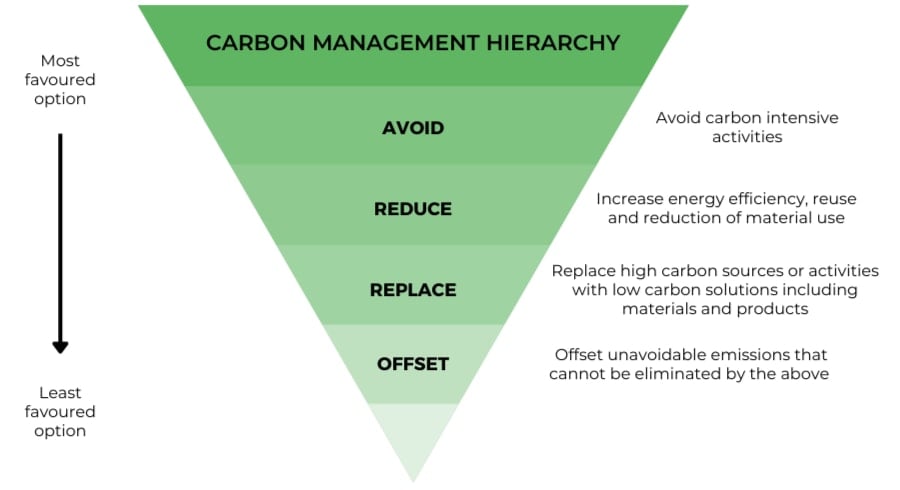
As mentioned previously, this clause presents the perfect opportunity to agree the actions that will reduce the organisations contribution to climate change. It’s best practice to align these goals with the business objectives, and I recommend using the Carbon Management Hierarchy:

Clause 8 – Operational Planning and Control
In this clause you need to take a number of steps, including:
- establishing the operational controls to implement the EMS actions
- finding methods to mitigate risk
- taking advantage of opportunities
- considering the environmental aspects and compliance requirements.
This clause also encourages you to further implement sustainable design and operational considerations and apply them to products, service procedures and business process controls.
What would this look like? You might include measures to ensure business continuity through the supply chain in changing global conditions. You could implement environmental travel planning for employees on company business, or specify sustainable requirements for contractors. You could also implement effective methods of calculating your business’ carbon footprint.

Clause 9 – Monitoring, Measurement, Analysis and Evaluation
As expected, there will be significant monitoring and measurement requirements associated with climate related issues. This will provide the business with effective data for evaluation and decision making. This could include, to name a few:
- stack emissions, on-site combustions and process related emissions
- consumption and GHG calculations on the different energy sources and fuels
- transport data
Again, if that list leaves your head spinning, don’t worry, it will become clearer as you work through implementation. If these aspects are relevant to your company, someone on the team is likely to have the skills to handle them.

Clause 10 – Improvement
The ISO standards are built on the concept of continual improvement. All the clauses in ISO 14001 can be used to promote a reduction of your business’s impact on climate change. The EMS should be continually improved, and environmental performance enhanced.
Ask Me Anything
Managing climate risk and reducing greenhouse gas emissions is important for all businesses, not just large organisations. We are all impacted by soaring energy costs and extreme weather. (Think back to the summer in 2021 when it was 40oC, and railways were buckling in the heat.) In addition, employees, customers and investors are all interested in the environmental credentials of business these days.
You might be familiar with all the technical terms I’ve included – but if you’re not, don’t worry. We at isoLogic are highly experienced in working with and explaining the details of gaining all ISO certifications.
isoLogic helps organisations, big and small, to implement and continually improve their Environmental Management Systems. We keep it relevant, practical and engaging. Plus we have a great track record of achieving successful certification.
Contact Us
Phone Number
0208 720 6851Email Address
meggan@isoLogic.co.ukLet’s Work Together!
From implementing and maintaining management systems to supporting your business with health, safety and wellbeing, isoLogic is here to support you. Contact us today to learn more.